
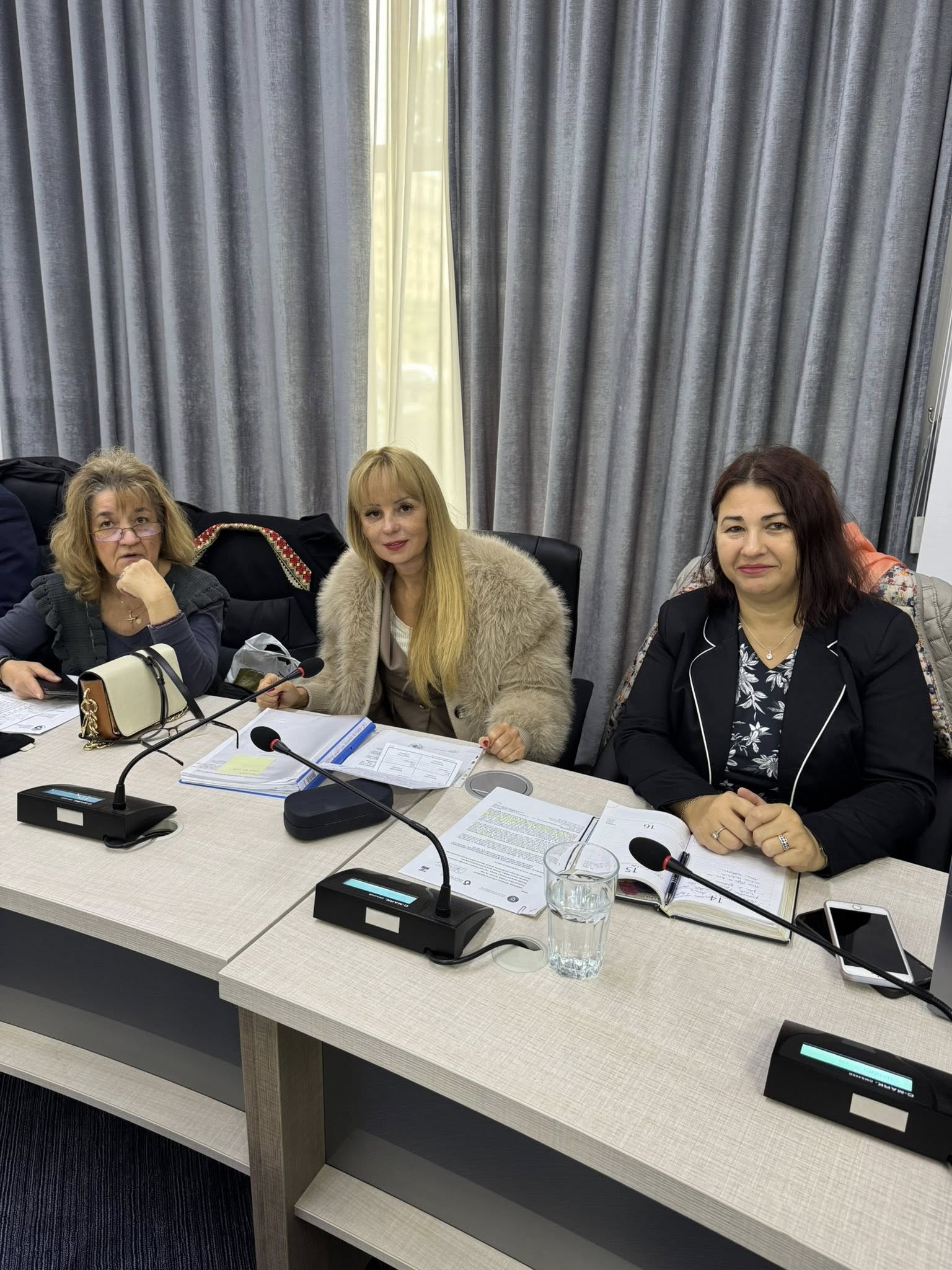
At the headquarters of the Ministry of Environment, Water and Forests (MEWF), the meeting of the Technical Analysis Committee (CAT) regarding the project „Industrial Wastewater Treatment Plant (WWTP) resulting from the Purolite Victoria factory and their discharge into the Olt River” took place on Wednesday, October 15, 2019, a project submitted by Purolite-Ecolab to obtain the operating authorization. We recall that the procedure regarding the authorization of the plant was taken over by MEWF after the Purolite company obtained an exception from the legal provisions for a facility built without authorization. The meeting was attended by the mayor of Victoria, Camelia Bertea, as well as Purolite-Ecolab representatives who provided answers to the questions raised by citizens during the public debate organized in Victoria on September 25, 2019.
- „,, The answers given, however, generated new questions and topics for discussion, and some important points still require clarification. We requested additions and improvements to the documentation, to ensure that people’s health and the city’s environment are protected. I assure all residents that, just as we took to the streets against olfactory discomfort, we are now actively involved so that, with the new station, such problems will never happen again,” explained Mayor Camelia Bertea.
The environmental activist from Codlea analyzed the Environmental Report
The most involved in environmental issues in Victoria is Agache Aurel Dionisie from Codlea, known for his work related to environmental issues. The activist claims that it is necessary to review the Environmental Report undertaken by Purolite-Ecolab for this objective.
- ,, Given that the purpose of the CAT meeting is to analyze the quality of the reports prepared by the holder (Purolite SRL), the observations received during the public debate period at national level and to determine whether it is necessary to revise the environmental impact report and the additions to the assessment study, I believe that they should be revised. Within this procedure, it is not the public that is obliged to carry out the technical analyzes and validations of the reports and studies submitted by the operators, but primarily the competent authority for environmental protection. The role of the public is to formulate observations and to signal aspects of public interest, and the role of the authority is to verify, validate or invalidate the technical and scientific substantiation of the documentation, explicitly assuming its own conclusions, and not to automatically adopt and validate, without critical analysis and in the absence of counter-evidence, the technical arguments invoked by the operator. In this context, I had hoped that, once the procedure was resumed at the central level by the Ministry of Environment, Forestry and Fisheries, the technical level of the assessment would be superior to that repeatedly recorded at the level of the Brașov Environmental Protection Agency, where the lack of assuming a clear technical point of view regarding the statements of the certified experts employed by the holder is most often manifested. I therefore request that the central authority, the Ministry of Environment, Forestry and Fisheries, fully exercise its powers: to request detailed technical clarifications, to order corrections, to reject or accept parts of the documentation based on an assumed and traceable technical analysis, so that the environmental decision is credible, verifiable and in the interest of environmental protection and public health,” Agache explains in a material submitted to the editorial office.
What Agache says should be revised
” Emission estimation based on measurements carried out in a pilot plant, in a controlled space, cannot reflect the dynamic behavior of real emissions from an industrial wastewater treatment plant located outdoors, where part of the basins are uncovered (at least from the submitted memorandum it does not appear that the entire plant is covered). The volatilization processes of organic and inorganic compounds in wastewater depend significantly on air temperature, wind speed, atmospheric pressure, solar radiation and air turbulence – factors that do not exist in a closed environment. The lack of these conditions makes the experimental data not representative of real operating situations. All these stages contribute, to varying degrees, to the release of volatile compounds and dissolved gases (amines, organic acids, nitrogen compounds, etc.). Therefore, a pilot plant that reproduces only part of the process cannot generate values representative of the WWTP .
„The methodology for estimating emissions is inadequate”
Another problem relates to determining emission flows from open basins, settling tanks or process tanks which, in the opinion of the environmental activist, is difficult and prone to large errors and recommends the use of analytical calculation methods , based on the physicochemical properties of pollutants and operating conditions.
- ,, The study does not take into account contributions from sludge handling, aeration basins (where diffuse air accelerates the transfer of pollutants to the atmosphere), and intermediate pipes and tanks. The report states that the values used in the dispersion model were „scaled” based on the results from the pilot plant. This procedure is scientifically unvalidated and introduces major uncertainties, as scaling factors cannot compensate for fundamental differences between laboratory and field conditions. The methodology for estimating atmospheric emissions used in the RIM is inadequate and insufficiently scientifically substantiated , as it is based on measurements in a controlled environment that do not reflect the real processes of gas transfer and volatilization in an operating treatment plant. The data obtained by this method cannot be considered representative and cannot be used in good faith as valid input values for modeling the dispersion of atmospheric pollutants. „It is necessary to completely rewrite the chapter „Estimates of Air Emissions” in the Report, according to environmental engineering principles and internationally recognized methodologies for diffuse sources of air pollutants,” explains Agache.
„I request the re-estimation of atmospheric emissions for the Purolite WWTP on engineering grounds”
Regarding the fact that the Purolite WWTP is not currently operating and therefore direct measurements at the emission sources could not be made, Agache specifies that, ” at the design stage of a treatment plant, the pollutant load at the inlet is known based on material balances and the characterization of the industrial wastewater generated by the technological process. These data allow the calculation of the quantities of volatile pollutants that can be released into the air at each treatment stage (neutralization, coagulation, aeration, settling, etc.), using established engineering formulas and emission factors documented in the technical literature. Therefore, the estimation of atmospheric emissions must be carried out analytically and engineeringly , using physico-chemical parameters of the wastewater and the operating conditions of the plant, not by empirical methods that are difficult to reproduce and without a solid physical basis. The absence of these calculations reduces the credibility of the assessment and limits the ability to substantiate the scenarios of pollutant dispersion in the air impossible to conduct a comparable analysis between the proposed technological scenarios (eg covering the basins, treating the polluted air). I request that the atmospheric emissions estimate for the Purolite WWTP be re-evaluated on an engineering basis ,” says Aurel Dionisie.
The report used meteorological data provided by the Sibiu Station
Another chapter of the Report contested by the Codlea activist refers to the meteorological analysis (chapter 6.6.4) in which data from the Sibiu meteorological station located over 50 km from Victoria were used. ,, Although you claim that local surface parameters were used , no analysis shows the representativeness of the Sibiu meteorological data set for the microclimate specific to the Victoria-Făgăraș area. There are only some statements and conclusions, without presenting any supporting evidence. The document does not present any quantitative comparison between the meteorological parameters of the Sibiu and Victoria (or Făgăraș) stations. There are no graphs, tables or time series to illustrate: the annual and seasonal distributions of wind direction and speed; the frequency and duration of periods of atmospheric calm; the distributions of atmospheric stability classes; the values of the height of the mixed layer and the frequency of thermal inversions. Without these correlations, the climatic representativeness of the meteorological data used cannot be demonstrated . There are significant topoclimatic differences between Sibiu and Victoria, and the Sibiu Station is located in an intramontane depression open to the west, with a pronounced westerly circulation, while Victoria is located directly at the foot of the northern slope of the Făgăraș Mountains, in an area strongly influenced by mountain–valley breezes, channeling effects of air currents on the Olt corridor, and frequent inversions during clear nights. A rigorous validation would have required: analysis of the 2010–2020 multiannual series; graphical and statistical comparisons; confirmation of stability classes and calm regimes. Without a demonstration of the representativeness of the meteorological data, the modeled dispersion may be erroneous , especially under the typical conditions of the area (downward night breezes and inversions). In the absence of a complete dataset from a local meteorological station, there are two technically correct options for substantiating the modelling: Full mesoscale chain modeling and Multiannual weather compatibility analysis (Sibiu vs. Victoria/Făgăraș). Without this meteorological validation, the atmospheric dispersion modeling results presented in the RIM cannot be considered representative of the microclimatic conditions in the Victoria area and must be reviewed before the study is approved. Regarding the statement in the response given by the MEWP ” The weather dataset was provided for a fee by the ANM, therefore we cannot make it available to you” In other words, „we cannot publish the weather data because we bought it from the public institution ANM”. This position denotes a retrograde mentality, specific to some administrative practices. Invoking the purchase „for a fee” does not justify the refusal to make available the environmental information used in the assessment. So the statement „we cannot publish because it is purchased” is not a legal basis for refusing public access to the weather information that underpins environmental modeling and decision-making „, explains Agache. In order to obtain the operating authorization for the treatment plant, a new public debate will be organized in Victoria. (Lucia BAKI)